Random featured paper
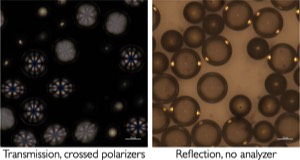
N. Popov, & J.P.F. Lagerwall, Frontiers in Soft Matter 2, 991375 (2022).
The combination of anisotropic boundary conditions and topological constraints acting on a spherical shell of nematic liquid crystal confined between aqueous phases gives rise to peculiar but well-defined configurations of the director field, and thus of the optic axis that defines the impact of the nematic birefringence. While the resulting optics of nematic shells has been extensively investigated in transmission, studies of the reflection behavior are scarce. Here we show that nematic shells exhibit specific light guiding paths mediated by birefringence-modulated total internal reflection (TIR) within the shell. With stabilizers promoting tangential boundary conditions, shells show immobile antipodal spots revealing the locations of maximum effective refractive index, but their intensity is modulated by the polarization of the illuminating light. With normal-aligning stabilizers, shells instead show bright arcs separated by dark spots, and these follow the rotation of the polarization of the illuminating light. Reflection polarizing microscopy thus offers a valuable complement to the more common characterization in transmission, adding data that can be helpful for accurately mapping out director fields in shells of any liquid crystal phase. Moreover, the TIR-mediated light guiding paths may offer interesting handles to localize photopolymerization of reactive liquid crystal shells or to dynamically modulate the response of light-triggered liquid crystal elastomer shell actuators.
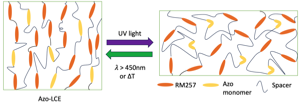
Najiya & J.P.F. Lagerwall, Adv. Opt. Mater. 13, 16, 2500160 (2025).
Photoresponsive liquid crystal elastomers (LCEs) that can undergo light‐induced actuation at a selected operation temperature range are potent functional materials that can be applied in diverse contexts, including biotechnology and soft robotics. Recent advances in LCE research highlighted the benefits of oligomeric precursors, which enable the use of 3D‐printing, microfluidic or other shear‐based processing to shape and simultaneously program the LCE. The synthesis of photoresponsive nematic LCE sheets derived from oligomers functionalized with azobenzene moieties is reported, followed by a systematic analysis of their actuation as a function of temperature with and without UV light irradiation. By studying the nematic–isotropic transition before and during UV irradiation the optimum photoactuation operating temperature is identified. For the LCEs, this is found to be as low as 30 °C, with near‐identical performance at 37 °C. This renders them ideal for application in biotechnological contexts, hence the new LCEs may enable isothermally operated soft actuators embedded in organoids or living systems. It is discussed how this can be achieved without exposing the cells to harmful UV light.
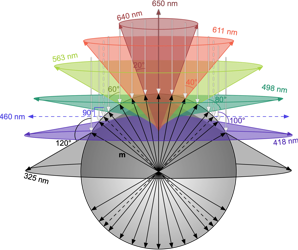
J.P.F. Lagerwall. SPIE San Francisco meeting; Emerging Liquid Crystal Technologies XIX (2024).
Cholesteric Spherical Reflectors (CSRs) are omnidirectional selective retroreflectors enabled by the ability of cholesteric liquid crystals (CLCs) to self-assemble with helicoidally modulated long-range orientational order, turning them into a liquid chiral photonic crystal with one-dimensional periodicity. The liquid state allows us to easily mold the CLC into spherical units, with stabilizers in the surrounding liquid phases ensuring the appropriate boundary conditions. By varying the composition of the CLC we can continuously tune the wavelength band of retroreflection across the visible spectrum and into the ultraviolet (UV) as well as infrared (IR) regimes, choose whether the CRSs reflect right- or left-handed circular polarization, and we can make them polymerizable, such that the CSRs are easily turned into solids after annealing, allowing easy manipulation and incorporation into diverse matrices. This opens for numerous innovative applications, from anti-counterfeiting and supply chain track-and-trace solutions, via human-invisible signage optimized for robots and AR device wayfinding, to the pixelation of structural color for generating non-spectral colors without absorption or indiscriminate scattering, and even enhanced-sensitivity disease testing. In my talk, I will briefly introduce the concept of CSRs and highlight their salient features, and then I will focus on our on-going efforts to solve important societally and industrially relevant problems by taking advantage of the opportunities offered by CSRs.
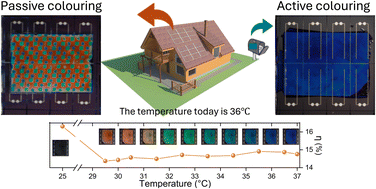
Y.-S. Zhang, H. Arif Yetkin, H. Agha, S. Gharabeiki, R. Kizhakidathazhath, L. Merges, R.G. Poeira, J.P.F. Lagerwall & P.J. Dale, Energy & Env. Sci., 18, 884-896 (2025).
While the current surging global energy crisis highlights the urgent need for a transition to renewable energy sources, the large physical footprint—as experienced by humans—of the required installations reduces public acceptance and therefore strongly hampers its development. Solar modules, for electricity and/or for heating, do not have the audible impact of wind turbines but their visible impact is currently prohibitive for many installation options, such as on the façades of buildings. Here we show that coatings of cholesteric liquid crystals (CLCs) can turn any black solar modules into passive surfaces with arbitrary colour or active surfaces with temperature sensitive colouration, yet with minimum loss of power conversion efficiency (PCE), thanks to their self-organized helical modulation generating structural colour. Most conspicuously, we combine red, green, and blue pixels to generate a non-spectral colour that blends into wooden or metallic backgrounds with a 50% relatively higher PCE than a ceramic ink equivalent since CLCs neither absorb nor scatter light. Further, we show thermochromic solar cells with colour tunable across the full visible spectrum, maintaining 88% of their original PCE. We argue these coatings can be developed to cover solar modules with either arbitrary full-colour images, allowing them to be aesthetically integrated into building façades and roofs in a way that is fully acceptable by the public, or with active colour changing to add functional value, while always keeping high PCE.
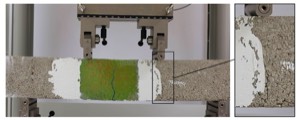
T. Čamo, R. Kizhakidathazhath, D. Waldmann-Diederich & J.P.F. Lagerwall, Struct. Health Monitor., 25, 1, 537-549 (2026).
As one cannot know in advance where a crack will form, currently used discrete crack monitors may miss to detect a crack if it grows outside the monitored regions. A high-resolution continuous 2D strain monitor applied to the entire surface of interest would solve this problem. Cholesteric liquid crystal elastomers (CLCEs) provide this ability, and with recent advances in chemistry, they can be applied very easily, similar to a paint coating. Here we demonstrate the detection of new cracks and monitoring of their progression using CLCE coatings applied to an extruded polystyrene insulation panel, an aerated concrete brick, and a reinforced concrete beam, respectively. Regardless of where and in which direction a crack develops, it can be easily detected thanks to a change in color. By analyzing the new color, quantitative information on the crack width can be extracted. Considering the ease of applying the CLCEs to standard building materials, the high 2D resolution strain monitoring with clear optical detection that it provides, and the low cost of the solution, we argue that CLCE coatings can have a revolutionary impact on structural health monitoring for buildings and infrastructure, to be constructed or already existing.
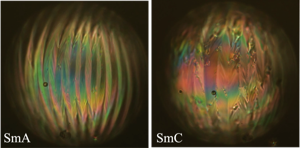
A. Sharma, M. Magrini, Y. Han, D.M. Walba, A. Majumdar & J.P.F. Lagerwall, Soft Matter, 20, 9586-9596 (2024).
The layered structure of smectic liquid crystals cannot develop unobstructed when confined to spherical shells with layers extending in the radial direction, since the available cross section area increases from the inside to the outside of the shell yet the number and thickness of layers must be constant. For smectic-A (SmA) liquid crystals, with the layer normal m parallel to the director n, the frustration breaks up the texture into spherical lune domains with twist deformations of alternating sense, overlaid with a herringbone-like secondary modulation and mediated via localized bend regions where the boundary conditions are violated. The SmC phase has more degrees of freedom to resolve the frustration thanks to its non-zero tilt angle τ between n and m, but its response to tangential shell confinement was never studied. We show experimentally and theoretically that the lunes in shells undergoing a SmA–SmC transition become twice as wide and half as many and they lose the secondary modulation, adopting a configuration with no layer twist but uniform layer bend if τ reaches a large enough value. Our study expands our understanding of how smectics respond to spherical confinement and it opens new soft matter research opportunities, given the rich diversity of phases with SmC-like symmetry, including chiral and spontaneously polarized phases.
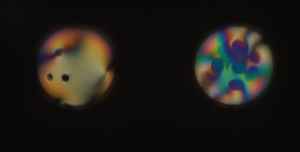
Y. Han, J.P.F. Lagerwall & A. Majumdar, Phys. Rev. E, 109, 064702 (2024).
The transition from a nematic to an isotropic state in a self-closing spherical liquid crystal shell with tangential alignment is a stimulating phenomenon to investigate, as the topology dictates that the shell exhibits local isotropic points at all temperatures in the nematic phase range, in the form of topological defects. The defects may thus be expected to act as nucleation points for the phase transition upon heating beyond the bulk nematic stability range. Here we study this peculiar transition, theoretically and experimentally, for shells with two different configurations of four +1/2 defects, finding that the defects act as the primary nucleation points if they are co-localized in each other's vicinity. If the defects are instead spread out across the shell, they again act as nucleation points, albeit not necessarily the primary ones. Beyond adding to our understanding of how the orientational order-disorder transition can take place in the shell geometry, our results have practical relevance for, e.g., the use of curved liquid crystals in sensing applications or for liquid crystal elastomer actuators in shell shape, undergoing a shape change as a result of the nematic-isotropic transition.
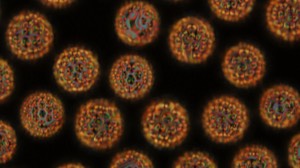
X. Ma, Y. Han, Y.-S. Zhang, Y. Geng, A. Majumdar & J.P.F. Lagerwall, Nat. Commun., 15, 1404 (2024).
Multiple emulsions are usually stabilized by amphiphilic molecules that combine the chemical characteristics of the different phases in contact. When one phase is a liquid crystal (LC), the choice of stabilizer also determines its configuration, but conventional wisdom assumes that the orientational order of the LC has no impact on the stabilizer. Here we show that, for the case of amphiphilic polymer stabilizers, this impact can be considerable. The mode of interaction between stabilizer and LC changes if the latter is heated close to its isotropic state, initiating a feedback loop that reverberates on the LC in form of a complete structural rearrangement. We utilize this phenomenon to dynamically tune the configuration of cholesteric LC shells from one with radial helix and spherically symmetric Bragg diffraction to a focal conic domain configuration with highly complex optics. Moreover, we template photonic microparticles from the LC shells by photopolymerizing them into solids, retaining any selected LC-derived structure. Our study places LC emulsions in a new light, calling for a reevaluation of the behavior of stabilizer molecules in contact with long-range ordered phases, while also enabling highly interesting photonic elements with application opportunities across vast fields.
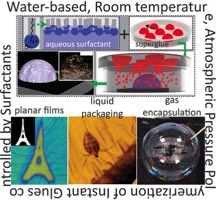
V.S.R. Jampani, M. Škarabot, U. Mur, D. Baigl, U. Jonas, J.P.F. Lagerwall, M. Ravnik, M. Anyfantakis, Adv. Mater., 36, 40, 240843 (2024).
Thin polymer films (TPFs) are indispensable elements in numerous technologies ranging from liquid encapsulation to biotechnology to electronics. However, their production typically relies on wet chemistry involving organic solvents or chemical vapor deposition, necessitating elaborate equipment and often harsh conditions. Here, an eco-friendly, fast, and facile synthesis of water-templated interfacial polymers based on cyanoacrylates (superglues, CAs) that yield thin films with tailored properties is demonstrated. Specifically, by exposing a cationic surfactant-laden water surface to cyanoacrylate vapors, surfactant-modulated anionic polymerization produces a manipulable thin polymer film with a thickness growth rate of 8 nm min−1. Furthermore, the shape and color of the film are precisely controlled by the polymerization kinetics, wetting conditions, and/or exposure to patterned light. Using various interfaces as templates for film growth, including the free surface of drops and soap bubbles, the developed method advantageously enables in situ packaging of chemical and biological cargos in liquid phase as well as the encapsulation of gases within solidified bubbles. Simple, versatile, and biocompatible, this technology constitutes a potent platform for programmable coating and soft/smart encapsulation of fluids.
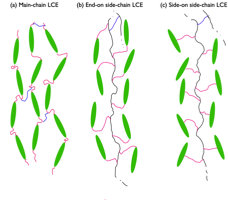
J.P.F. Lagerwall, Prog. Mater., 1, e9 (2023).
Liquid crystal elastomers (LCEs) are programmable materials par excellence. I review the history and state of the art of LCE materials and processing development from the perspective of the important remaining step of moving out of the academic research lab and applying LCEs as soft actuators or strain sensors. After a brief introduction for the non-expert of what LCEs are and which their main advantages and limitations are, I discuss the key breakthroughs that LCE research has undergone over its 50-year history. Building on this and drawing from fresh results from on-going research, I consider possible future development trajectories that would help address the outstanding key obstacles to reach mass production at competitive cost. I end with discussing a selected set of application scenarios with good opportunities for LCEs to perform functions that no other material could deliver. Specifically, I focus on responsive buildings incorporating LCE actuator fibres and sheets/ribbons, structural health monitoring with LCE strain sensors monitoring crack growth and propagation or alerting residents of buildings exposed to dangerous levels of deformation, and kinetic and responsive garments incorporating LCE fibre actuators and/or strain sensors.
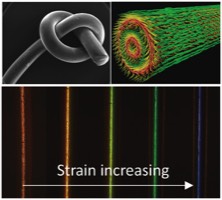
Y. Geng & J.P.F. Lagerwall, Adv. Sci., 10, 9, 2301414 (2023).
Cylindrically symmetric cholesteric liquid crystal elastomer (CLCE) fibers templated by tubular confinement are reported, displaying mechanochromic, thermochromic, and thermomechanical responses. The synthesis inside a sacrificial tube secures radial orientation of the cholesteric helix, and the ground state retroreflection wavelength is easily tuned throughout the visible spectrum or into the near-infrared by varying the concentration of a chiral dopant. The fibers display continuous, repeatable, and quantitatively predictable mechanochromic response, reaching a blue shift of more than -220 nm for 180% elongation. The cylindrical symmetry renders the response identical in all directions perpendicular to the fiber axis, making them exceptionally useful for monitoring complex strains, as demonstrated in revealing local strain during tying of different knots. The CLCE reflection color can be revealed with high contrast against any background by taking advantage of the circularly polarized reflection. Upon heating, the fibers respond-fully reversibly-with red shift and radial expansion/axial contraction. However, there is no transition to an isotropic state, confirming a largely forgotten theoretical prediction by de Gennes. These fibers and the easy way of making them may open new windows for large-scale application in advanced wearable technology and beyond.
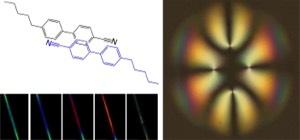
J.P.F. Lagerwall, Liq. Cryst., 51, 8-9, 1296-1310 (2023).
Liquid crystal-forming cyanobiphenyls are truly extraordinary molecules that have had an enormous impact on liquid crystal research and applications since they were first synthesised. This impact is, on the one hand, due to the exceptionally convenient physical properties of the main characters, 5CB and 8CB, allowing easy experiments at room temperature, as well as their commercial availability at reasonable cost. On the other hand, the cyanobiphenyl chemical structure leads to some quite peculiar characteristics in terms of organisation at the molecular scale, which are sometimes well recognised and even utilised, but often the awareness of these peculiarities is not strong. This perspective article reviews the use of cyanobiphenyls in making liquid crystal shells and liquid crystal core fibres, in sensing, as a medium for simultaneously aligning and dispersing carbon nanotubes, and as highly useful solvents for reactive mesogens that can be polymerised into anisotropic networks. This choice is very much motivated by how cyanobiphenyls have impacted our group’s research throughout the years, which is the basis for the examples I provide. Nevertheless, I believe they serve well to illustrate the immense usefulness of cyanobiphenyls in innovating research and applications related to liquid crystals.
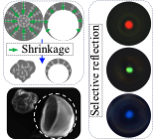
Y. Geng, C. Honorato-Rios, J.H. Noh & J.P.F. Lagerwall, Adv. Mater., 36, 8, 2305251 (2023).
The wavelength- and polarization-selective Bragg reflection of visible light exhibited by films produced by drying cholesteric liquid crystal (CLC) suspensions of cellulose nanocrystals (CNCs) render these biosourced nanoparticles highly potent for many optical applications. While the conventionally produced films are flat, the CLC-derived helical CNC arrangement would acquire new powerful features if given spherical curvature. Drying CNC suspension droplets does not work, because the onset of kinetic arrest in droplets of anisotropic colloids leads to severe buckling and loss of spherical shape. Here, these problems are avoided by confining the CNC suspension in a spherical microshell surrounding an incompressible oil droplet. This prevents buckling, ensures strong helix pitch compression, and produces single-domain cholesteric spherical reflector particles with distinct visible color. Interestingly, the constrained shrinkage leads to spontaneous puncturing, leaving every particle with a single hole through which the inner oil phase can be extracted for recycling. By mixing two different CNC types at varying fractions, the retroreflection color is tuned throughout the visible spectrum. The new approach adds a versatile tool in the quest to utilize bioderived CLCs, enabling spherically curved particles with the same excellent optical quality and smooth surface as previously obtained only in flat films.
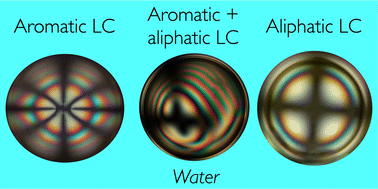
A. Sharma,R. Kizhakidathazhath & J.P.F. Lagerwall, Soft Matter, 19, 2637-2645 (2023).
We carry out a strategic and systematic variation of the molecular structure of liquid crystals (LCs) molded into spherical shells, surrounded by aqueous isotropic phases internally and externally. Contrary to common expectation, based on previous studies that have almost exclusively been carried out with cyanobiphenyl-based LCs, we find that the director field aligns normal to the LC–water interface when we use an LC molecule that is entirely non-aromatic. We propose to explain this by the inability of such an LC to participate in hydrogen bonding, rendering the normal configuration favorable as it minimizes the molecular cross section in contact with the water. We also find that cyano-terminated LC molecules contribute greatly to stabilizing the LC–water interface. This explains why shells made of cyanobiphenyl LCs are much more stable than shells of LCs with non-cyano-terminated molecules, even if the latter exhibit aromatic cores. Unstable LC shells can be stabilized very efficiently, however, through the addition of a low concentration of molecules that are cyano-terminated, preferably below the threshold for dimerization. Our study provides a much clarified understanding of how the molecular structure dictates the stability and alignment of LC shells, and it will enable a diversification of LC shell research and applications to systems where the use of non-cyanobiphenyl LCs is required.
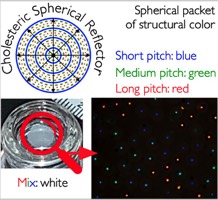
H. Agha, Y.-S. Zhang, Y. Geng & J.P.F. Lagerwall, Adv. Photon. Res., 4, 4, 2200363 (2023).
While structural color is a powerful means of obtaining saturated and durable pigments that minimize absorption, scattering, and negative environmental impact, appearing naturally in animals and plants as well as in carefully designed artificial composites, it is fundamentally limited to spectral colors, leaving white and other mixed colors elusive. It also normally suffers from a strong viewing angle dependence, making color definition difficult. Herein, it is demonstrated that these challenges can be overcome by using cholesteric spherical reflectors (CSRs), spheres of polymerized cholesteric liquid crystal with radial alignment of the self-assembled helical structure. Exhibiting omnidirectional selective retroreflectivity of well-defined color, CSRs are discrete “packages” of structural color. This allows them to be used as pixels for generating nonspectral colors, following the principle of digital displays. A method of creating densely packed monolayers of CSRs with red (R), green (G), and blue (B) retroreflection is developed. Mixing them in equal proportions gives a white surface. By embedding the CSRs in an index matching transparent medium, nonselective specular reflections and scattering are avoided. The approach can be used to create arbitrary colors, including nonspectral ones, without any absorption or nonselective scattering, opening doors to decorating surfaces as desired while minimizing light loss.
.
Publications in Scientific Journals
Click here for a list of all my scientific journal articles and preprints.
Theses
Click here for an overview of the theses I've written over the years, together with download links.
Patents, book chapters and books
Here is a list of published book chapters, and here is a list of accepted patents.
Recorded talks
Here you can watch screen recordings of some talks I've given at conferences.

Profile on Google Scholar
ORCID ID 0000-0001-9753-1147
Scopus Author ID 6602191293